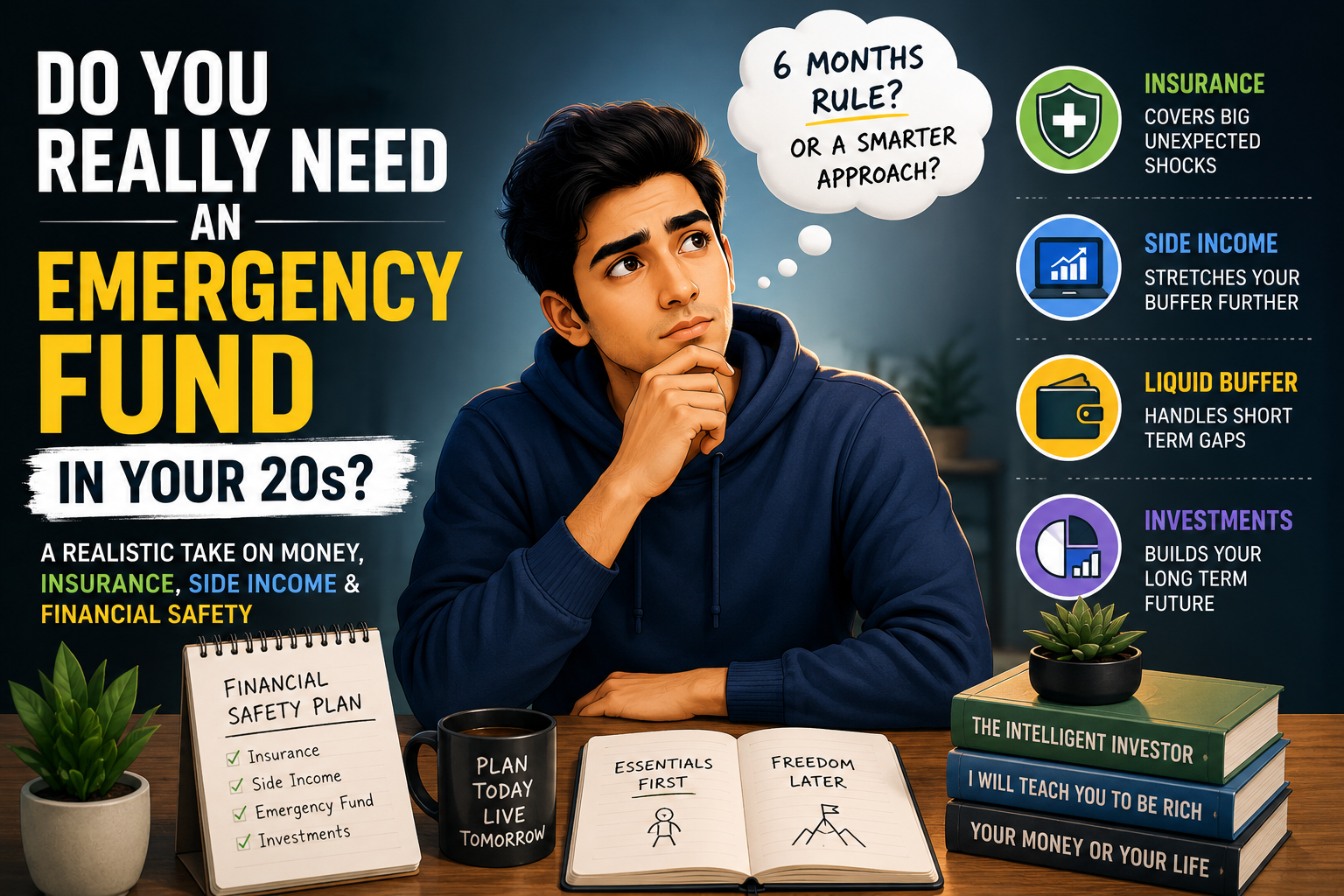
Most personal finance advice in India starts the same way: build 6 months of emergency savings before you do anything else.
And yet, according to a survey by personal finance platform Finology, 75% of Indians don't have emergency funds at all. The rule everyone keeps repeating is the rule almost nobody actually follows.
I'm in that 75%. Sort of.
I earn a modest early-career salary, invest a chunk of it every month through SIPs, and keep a small buffer in my savings account. Not a structured 6-month corpus. Just a cushion I refill when it dips.
Not because I'm careless. But because I've started thinking about financial safety differently.
My protection doesn't come from one bucket of money sitting idle. It comes from a system of layers. And once you build that picture in your head, the "6-month rule" starts feeling a lot less absolute.
🧠 Why the 6-month rule is incomplete
The rule assumes one specific worst case: you lose your job, income drops to zero, and you have nothing else protecting you.
Under those conditions - high EMIs, dependents, no insurance - yes, 6 months of savings is critical. A single-income family with ₹50,000 in monthly expenses would need ₹5-6 lakh just to survive 10-12 months without income.
But most people in their early 20s don't have that picture. No home loan. No dependents. Flexible lifestyle expenses. The rule was built for someone with a much heavier financial load and got copy-pasted onto everyone.
Let me show you what I mean with actual numbers.
Say your essential monthly expenses are ₹25,000. The 6-month rule says: keep ₹1.5 lakh sitting in a savings account earning 3-4% interest.
That's ₹1.5 lakh not in a mutual fund. Not compounding at 12%. Not working for you at all. Just sitting there, slowly losing ground to inflation.
If you're 23, that's an expensive insurance policy for a risk that may be smaller than you think.
🏥 Layer 1: Insurance absorbs the big shocks - but don't overestimate it
A lot of emergency funds are built to cover medical disasters. Hospital bills. Major surgeries. Things that can cost ₹2-5 lakh overnight.
Health insurance handles most of that - which is why getting covered early is so important.
But here's the uncomfortable reality: India has the highest medical inflation rate in Asia at 14%, and roughly 50% of healthcare expenses are still paid out-of-pocket. Even insured people end up paying for OPD visits, diagnostics, post-care, and non-covered procedures.
So insurance reduces the emergency fund burden significantly. It doesn't eliminate it.
Think of it this way: if a hospitalisation that would've cost ₹2 lakh out-of-pocket now costs you ₹25,000 after insurance, your emergency fund doesn't need to carry that ₹2 lakh risk anymore. But it still needs to cover that ₹25,000 gap.
That's very different from building a fund with no insurance at all.
💼 Layer 2: Small side income stretches your buffer further
The other assumption behind emergency funds is that job loss means zero income.
That's less true now than it used to be. Even a modest side income - ₹8,000-10,000/month from freelancing, tutoring, content writing, or any skill-based work - changes the math completely.
Say your monthly expenses are ₹25,000 and you have ₹50,000 in your buffer. Without side income, that's 2 months of runway.
Add ₹10,000/month in freelance income during a job gap, and that same ₹50,000 stretches to over 3.5 months. No extra savings. Just income flexibility.
It doesn't need to replace your salary. It just needs to buy you time while you figure things out.
💧 Layer 3: The buffer itself (what I actually keep)
I do keep money liquid. I'm not saying invest every rupee you earn.
My buffer sits in a savings account - not a rigidly sized fund, just a working cushion I'm aware of. Right now it covers roughly 2-3 months of my actual essential spending, not my total lifestyle.
I've used it for:
- A bike repair that came out of nowhere
- Bridging a month when I'd overspent on a trip
- A short course I hadn't planned for
It goes down. It comes back up. It's a working fund, not a fixed target I'm protecting.
✅ So how much should you actually keep?
It depends on your life right now. Here's the honest split:
A smaller buffer (1-3 months of essentials) may work if:
- No EMIs or major fixed obligations
- Health insurance is already in place
- You're living with parents or have low rent
- You have some ability to earn on the side
Build the full 6-month fund first if:
- You have an active home loan or car EMI
- You have parents or siblings financially dependent on you
- Your industry has had recent layoffs or your job feels uncertain
- You have no health insurance yet
The mistake isn't having too little emergency savings. The mistake is thinking savings is the only layer of safety you need.
💡 Tip: Where to keep your buffer
A regular savings account is fine. But if you want your buffer to earn more without locking it away, a liquid mutual fund is worth looking at - something like HDFC Liquid Fund or Parag Parikh Liquid Fund gives around 6-7% returns with same-day or next-day withdrawal. Better than watching your money earn 3% in a savings account, and still accessible when you need it.
🚀 Final word
Emergency funds matter. I'm not arguing against them.
But "6 months of savings, no exceptions" is a rule built for someone with a full picture of obligations - EMIs, dependents, no insurance. If that's not you yet, the rule doesn't have to be your number.
Think in layers instead. Insurance for the large shocks. Some income flexibility as a bridge. A liquid buffer for the gaps. And the rest compounding in the market.
That's not recklessness. That's just building safety that actually fits your life.
Got questions about how you're thinking about your own buffer? Drop a comment - I'd love to hear where you're at.