A few weeks before I started my first corporate job, I did what a lot of people do. I went out and bought a bunch of traditional corporate formal clothes. It cost me roughly ₹5,000. I just assumed it was a necessary entry cost for the corporate world.
By the end of my first week, I realized two things. Formals were completely optional at my office, and they were highly uncomfortable. I never wore them again. That ₹5,000 sat in my wardrobe as a total loss, a tiny monument to my lack of experience.
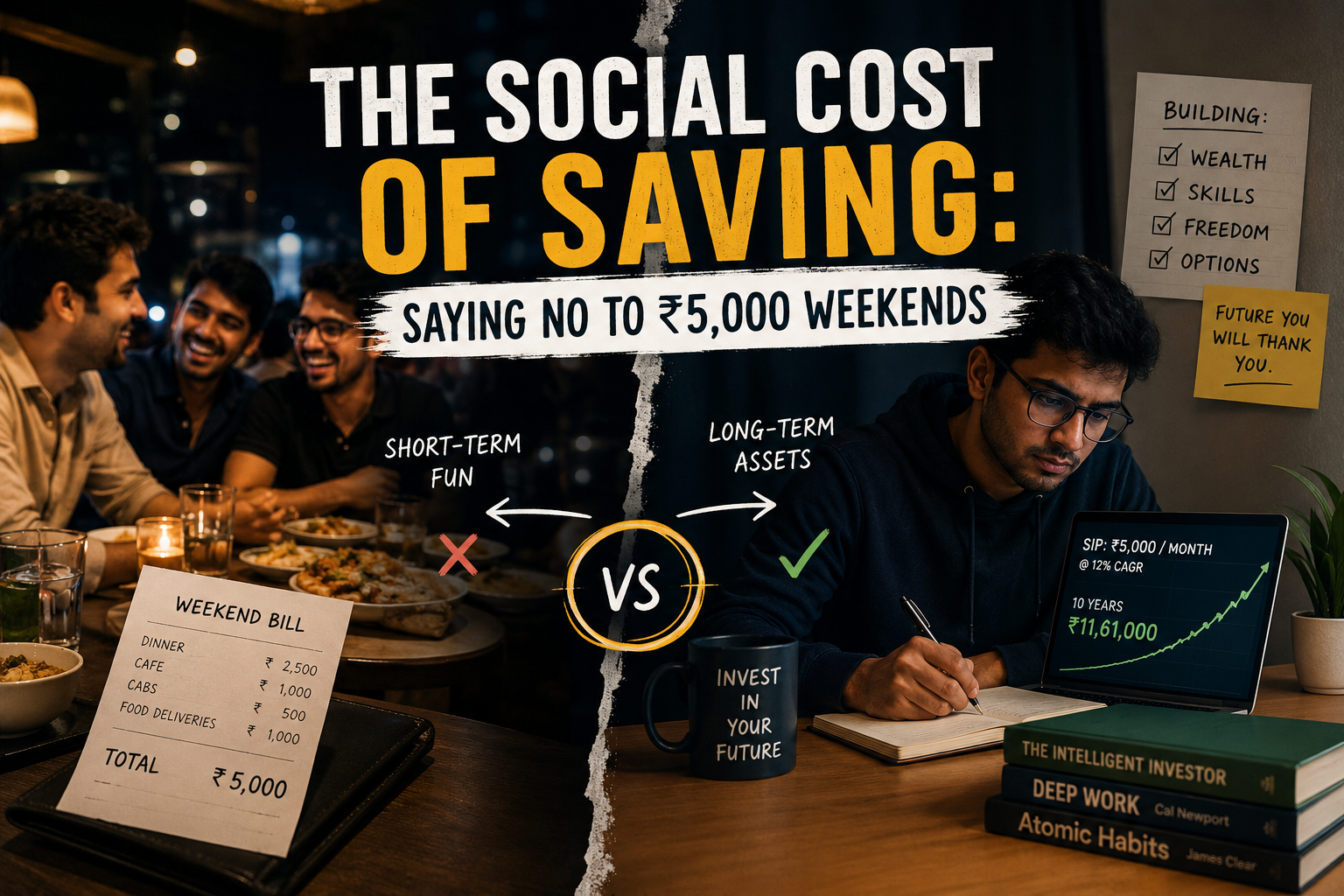
While that was a one-time mistake, the corporate world quickly introduced me to a much larger, recurring financial trap: the ₹5,000 weekend.
I have written before about aggressive investing at 23 and how I try to manage lifestyle inflation. But executing those strategies consistently requires addressing a factor that spreadsheets cannot capture. There is a real social cost to saving money, and to be completely honest, I am still figuring out how to balance it.
👥 The Pressure to Fit In
When you enter the corporate workforce, social life quickly centers around weekend spending. High-end dinners, premium cafes, and spontaneous weekend trips become the default settings for catching up with friends or networking with colleagues.
When I first mapped out my savings rate and automated my monthly SIPs, the numbers made one thing clear. I could not maintain my investment goals if I participated in every single social plan. I had to start saying no.
But making that choice introduces a lot of social friction. Look, it is not just a math problem. It is a psychological one.
When you consistently decline plans to protect your budget, you face the distinct discomfort of how your friends might perceive you. I used to worry constantly about being judged as the boring person who never leaves his room, or the friend who ruins the group dynamic by opting out.
The fear of isolation is very real. If you decline an invitation three times in a row, the group simply stops asking. That is why many young professionals compromise their long-term financial health just to avoid an awkward conversation on a WhatsApp group chat.
📊 Let's Break Down the Math
The emotional side matters, but money decisions eventually show up in numbers too.
We often tell ourselves that one dinner or one café visit will not hurt. But let us look at the actual numbers of a typical urban weekend.
Imagine you go out for a nice dinner on Friday night, split a premium meal, and take a couple of cabs. That is easily ₹2,500. On Sunday, you meet a friend at a trendy café for an iced latte and a snack, which runs you another ₹1,000. Add in a couple of online food deliveries because you are too tired to cook, and you have easily hit ₹5,000 in a single weekend.
If you do this just two weekends a month, that is ₹10,000 a month. Over a year, that is ₹1,20,000 vanishing from your potential wealth.
Let us look at what happens if you take just half of that money, ₹5,000 a month, and redirect it into a basic equity mutual fund compounding at a conservative 12% per year.
| Years of Saving | Total Cash Invested | Future Portfolio Value (at 12%) |
|---|---|---|
| 3 Years | ₹1,80,000 | ₹2,15,000 |
| 5 Years | ₹3,00,000 | ₹4,12,000 |
| 10 Years | ₹6,00,000 | ₹11,61,000 |
When you look at it this way, skipping a few expensive dinners ceases to be about deprivation. It becomes a choice about leverage. That ₹11 lakh down the line could be the seed capital for a business, a safety net that lets you leave a toxic job, or the freedom to make career moves without stressing over the next paycheck.
🚀 Trading Outings for Assets
Once I started becoming comfortable with skipping certain events, I realized I had accidentally freed up two valuable resources: extra cash and uninterrupted time.
I am no financial guru, and I do not have it all figured out, but I decided to treat my weekends as a period to invest in my own development. Some weekends I used that time to learn SQL, work on this website, or simply sit and think through my own financial goals.
The very platform you are reading this article on right now, Figuring Out Money, was built during those weekends when I chose to stay in.
The standard financial advice tells you how your money compounds in a mutual fund. But the compounding return on your own skills is often much higher. Spending a weekend learning a new tool or building a side project can create leverage that outpaces any index fund in the short term.
💡 The Bottom Line
I am not saying lock yourself in your room and reject every plan. Some of my best memories come from random outings with friends, and relationships matter just as much as wealth creation. The point is choosing intentionally rather than saying yes automatically out of habit or FOMO.
Choosing to optimize your finances in your early 20s requires making real trade-offs. It is completely normal to find it awkward to draw financial boundaries with your peers. I still feel that twitch of FOMO when I see updates from a weekend trip I skipped.
But true friends care about your company, not the price tag of the menu you are reading together. You don't have to skip every outing. But being intentional about which ₹5,000 weekends matter can quietly buy you more freedom later.
Have you ever bought something for a new job that you completely regretted? How do you handle the social pressure of weekend spending with your friend circle? Drop a comment below and let's figure it out together.