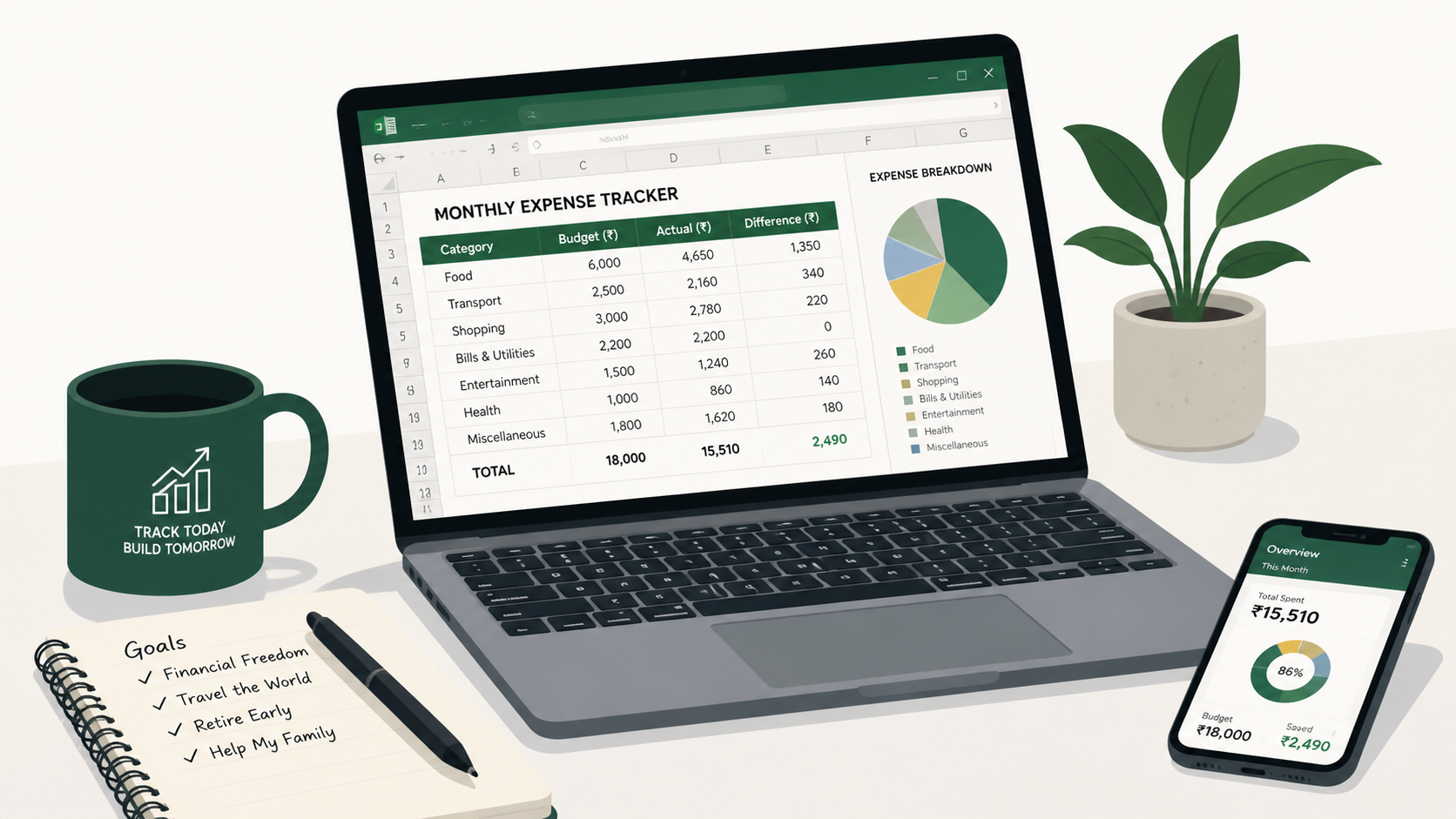
Most people don't have a money problem. They have a visibility problem.
Salary comes in. Bills get paid. UPI keeps firing. And whatever is left at the end of the month feels like savings - even when it isn't.
I used to operate that way too. Then I started recording every transaction in an Excel sheet, from a ₹50 auto ride to a ₹5,000 outing. That one habit changed how I think about money more than any investing article ever did.
Not because tracking makes you richer overnight. But because once you see your actual numbers, you can't un-see them.
The gap between what you think you spend and what you actually spend
India processed 228 billion UPI transactions in 2025 alone. That's not just a number about digital payments - it's a number about how invisible spending has become. Every chai, every Swiggy order, every impulse purchase on Amazon goes through in one tap and disappears from memory within minutes.
Meanwhile, India's household financial savings as a share of GDP have dropped from 11% in 2020-21 to around 5.3% in 2023-24 - a near-halving in just three years, according to RBI data. We're earning more, spending more, and saving less. And most of us couldn't tell you exactly why.
Here's a rough version of my May numbers. Total income around ₹38,000. Expenses around ₹14,500. Investments ₹22,500 - roughly 58% of income.
Looks clean on paper.
But April told a different story. Same income bracket, same intention - and I ended the month with ₹205 in balance. Practically zero.
The difference between those two months wasn't discipline. It was visibility. In April, I could see exactly where the month went wrong. Without tracking, I'd have just blamed the month and moved on.
That's what most people miss. They don't need more income. They need a clearer picture of where the current income is actually going. If you've ever wondered why a salary hike doesn't seem to change your savings, this is usually why - I wrote about that pattern in more depth here.
What my Excel sheet actually tracks
My tracker isn't just a log. It functions more like a personal finance dashboard.
I split everything into categories: home expenses, gas and transport, miscellaneous needs, eating out, personal care, subscriptions, culture, and miscellaneous wants. On the other side, I track SIPs, savings transfers, and any stock or ETF buys.
The number I care most about at the end of each month isn't total expenses. It's the real leftover - after actual spending and actual investing are both accounted for.
Most people calculate savings like this: salary minus a rough estimate of expenses. That's not savings. That's a guess. Real savings is what remains when you've been honest about everything, including the ₹2,500 culture category you forgot to count.
The category that shocked me
When I first started tracking, one number stopped me cold: eating out.
I genuinely thought I was being reasonable about it. ₹220 here for lunch. ₹150 for a tea run with colleagues. A ₹300 order on a lazy Sunday. Each transaction felt like a small, justified decision.
Then I saw the monthly total. Closer to ₹3,500-4,000. Sometimes more.
That number didn't make me feel guilty. It made me feel stupid - in the useful way. Because I hadn't chosen to spend that much on eating out. It had just happened, automatically, one small transaction at a time. The moment I saw it clearly, I could actually decide what I wanted to do about it.
That's the thing about invisible spending. You can't fight what you can't see.
The gifting problem no one talks about
The other category that surprised me was gifting.
Some gifting is meaningful. I'm happy to spend on people who genuinely matter to me.
But a lot of gifting in your 20s isn't generosity - it's social pressure wearing a smile. Office collections for people you barely know. Birthday gifts for relationships that aren't reciprocal. Occasions where you'd feel awkward saying no.
Before I tracked, I'd write these off as unavoidable. After tracking, I started asking a harder question: is this person someone who creates positive value in my life?
That one question - applied consistently - can save a meaningful amount every month. Not by becoming stingy, but by being deliberate.
This connects to something larger about lifestyle spending that tends to creep up quietly. I wrote about how that compounding effect works in Why Your Salary Doubled But Your Savings Didn't - worth reading alongside this one.
Why tracking makes investing easier
Only 6% of Indians invest in mutual funds. That's a striking number - but what's more striking is how many people who do start SIPs end up pausing or stopping them within a year. Usually because the target was set on optimism, not on what their cash flow could actually support.
I try to invest 50-60% of my take-home salary every month and 60% of any bonus I receive. The remaining 40% of a bonus goes into a savings account as a cushion.
That target only works because I know my actual numbers. Without tracking, I'd be guessing - and an investment target based on a guess fails in a bad month, which is exactly when you need the discipline most.
Tracking lets you invest from truth, not intention. There's a meaningful difference between the two. I went into how I actually structure those investing decisions in How I Am Investing Aggressively at 23 and Beyond SIP: How I Actually Decide Where My Extra Money Goes.
Why I use Excel and not an app
I've downloaded more expense apps than I can count. I stopped using all of them - not because they're bad, but because they make assumptions about how you want to see your money. The categories are theirs, the dashboards are theirs, the logic is theirs.
Excel gives me control. I built the categories I actually use. I added a portfolio section that tracks my mutual fund positions, market value, and unrealised profit per fund. Account-wise balances, net worth, month-over-month comparisons - all in one place, structured exactly how I think.
The best system isn't the most feature-rich one. It's the one you'll actually maintain. For me, that's Excel.
How to start today
Don't start with a budget. Start with awareness.
Track every expense for 30 days with zero judgment. Don't try to change anything. Just record.
Then do three things:
- Find your top two or three waste categories
- Write down your actual financial goals
- Set your SIP based on real surplus, not hoped-for surplus
That last step is the one most people skip - and it's the one that makes everything else stick. If you're not sure what your surplus should be going toward, this piece on emergency funds is a good place to start before you set any investing targets.
Here's the Excel tracker I personally use - free to download: Download the free tracker here
It covers income logging, expense categories, investment tracking, and net worth in one sheet. Make a copy and start with this month.
You already have enough information to start. What you're missing is the picture. This gives you the picture.